The opening image of Batman: Knightfall Part 1: Knightfall is not the Bat-Signal cutting through the smog, but the smoke rising from the ruins of Arkham Asylum. It’s a deliberate, ominous choice for a film that understands the assignment: this is not a story about a victory lap. Released digitally on June 23, this 79-minute animated powerhouse strips away the usual preamble and drops us directly into the worst-case scenario. The madhouse is gone, and Gotham’s most dangerous are running loose. For Bruce Wayne, there is no time to plan, only to react. For the man called Bane, there is only the perfect moment to strike.
Director Jeff Wamester has crafted a lean, brutal machine of a movie. The runtime is tight - almost punishingly so - and it works in the film’s favor. There’s no fat here, no wasted establishing shots of the Wayne Manor library or Alfred’s dry wit. From the first frame, we are in crisis mode. The screenplay, adapted from the legendary 1993 comic arc, wisely understands that the Knightfall saga is not merely about a villain breaking the Bat. It’s about the slow, grinding attrition of a man who refuses to stop. Anson Mount delivers a Bruce Wayne who sounds exhausted in a way we haven’t heard before. His Batman is clipped, efficient, and already carrying the weight of a hundred impossible nights. When he rasps orders to an overwhelmed Commissioner Gordon (a reliably stoic Bruce Boxleitner), you feel the strain in his vocal cords. This is a hero running on fumes, and Mount sells every ounce of that fatigue.
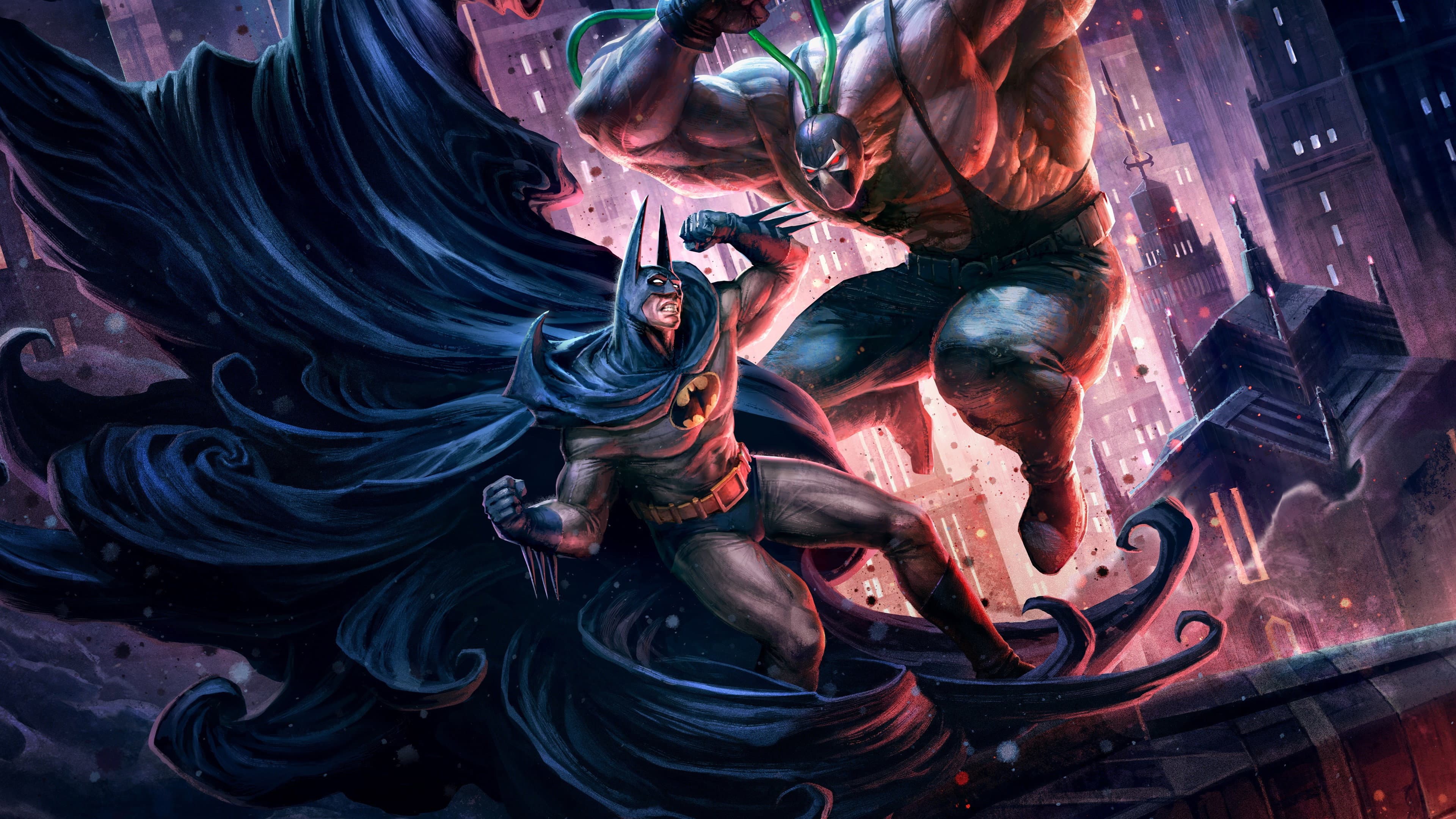
The film’s structure is that of a relentless gauntlet. As Batman races to round up the recently freed Rogues Gallery, we get a greatest-hits montage of confrontations. It’s a smart narrative choice that avoids the trap of bloated runtime. The Joker is absent, but the film doesn't need him. Instead, we get a fantastic turn from Jeff Bennett as the Ventriloquist and Scarface, a dual role that lands somewhere between creepy and tragic, and a brief but memorable appearance from Luis Bermudez’s Catman. These are not just cannon fodder. Each encounter is designed to carve a little more off Batman’s physical and mental reserves. Wamester directs these fight scenes with a brutal choreography that favors impact over flair. Every punch lands with a sickening thud. The animation style is sleek, with a neo-noir palette that leans heavily on deep blues and blood reds, making the chaos of a city under siege feel both stylized and tactile.
But the true star of the piece is Michael Mando’s Bane. This is not the grunting, posturing brute of some prior adaptations. Mando’s voice is a low, controlled purr of intellect and menace. His Bane is a tactician first and a destroyer second. The film wisely grants him scenes away from the action, where we see him observing, calculating, and dismantling Batman’s legend from the outside. The dialogue here - translated cleanly for the English audio - is sharp and psychological. When Bane speaks, he doesn’t just threaten; he dissects. He understands that breaking Batman requires more than strength; it requires breaking his spirit through sheer, overwhelming pressure. Mando’s performance is chilling precisely because he sounds so reasonable while planning the most unreasonable act of violence imaginable.
The supporting cast elevates the material significantly. Pablo Schreiber’s Azrael, Jean-Paul Valley, lurks in the margins, a ticking time bomb of unearned arrogance. His scenes with Batman are tense, hinting at the ideological clash to come in Part 2. Jessica Camacho’s Renee Montoya provides a grounded, street-level perspective, reminding us that Gotham’s police are fighting a war they can’t win. The script gives her just enough to do, painting a portrait of a detective who knows the Bat is on his last legs and fears what comes next. The inclusion of Anthony Crivello as Franco Bertinelli adds a touch of mobster gravitas to the proceedings, anchoring some of the chaos in human criminality rather than just supervillainy.
The film’s climax is a masterclass in tension. By the time Batman finally corners Bane, the viewer has been conditioned to expect a standard punch-up. Instead, Wamester delivers a fight that is almost difficult to watch. The animation leans into the horror of the physical mismatch. This Batman is slow, his blocks are sloppy, and every hit he lands is answered with a devastating counter. The sound design - the crunch of bone, the ragged breathing - puts you right in the center of the beating. It’s a long, uncomfortable sequence that doesn’t feel heroic. It feels like watching a natural disaster happen to a good man. The film earns its 8.2 TMDb rating not through crowd-pleasing spectacle, but through its unwavering commitment to showing the cost of the cowl.
There is a reason this is called Part 1. The film ends not with a victory, but with a shattering, tragic inevitability. A new Dark Knight stands in the shadows, but the silhouette is wrong. The last shot is a promise of conflict to come, leaving the audience with a queasy feeling of dread rather than satisfaction. Batman: Knightfall Part 1: Knightfall is a superhero film that understands its job isn't to inspire, but to break you down until you’re ready for the rebuilding. It’s a dark, focused, and supremely confident piece of animation that gives the Bat-family mythos the grim, adult weight it so often promises but rarely delivers. The house of cards is built. We now wait for the wind to blow.